Ning E

Aligning MLLMs with the Latent Structure of Human Cognition via Behavior-Derived Semantic Dimensions

1School of Biomedical Engineering, ShanghaiTech University
2Institute of Automation, Chinese Academy of Sciences
3School of Future Technology, University of Chinese Academy of Sciences
4School of Artificial Intelligence, University of Chinese Academy of Sciences
5Zhongguancun Academy

CogAlign aligns MLLMs with the latent structure of human cognition by moving beyond outcomes to underlying cognitive processes through linguistic rationales grounded in behavior-derived semantic dimensions, improving behavioral agreement and neural representational alignment.

Scroll for overview
Overview
Human Decision
Start with human similarity judgments

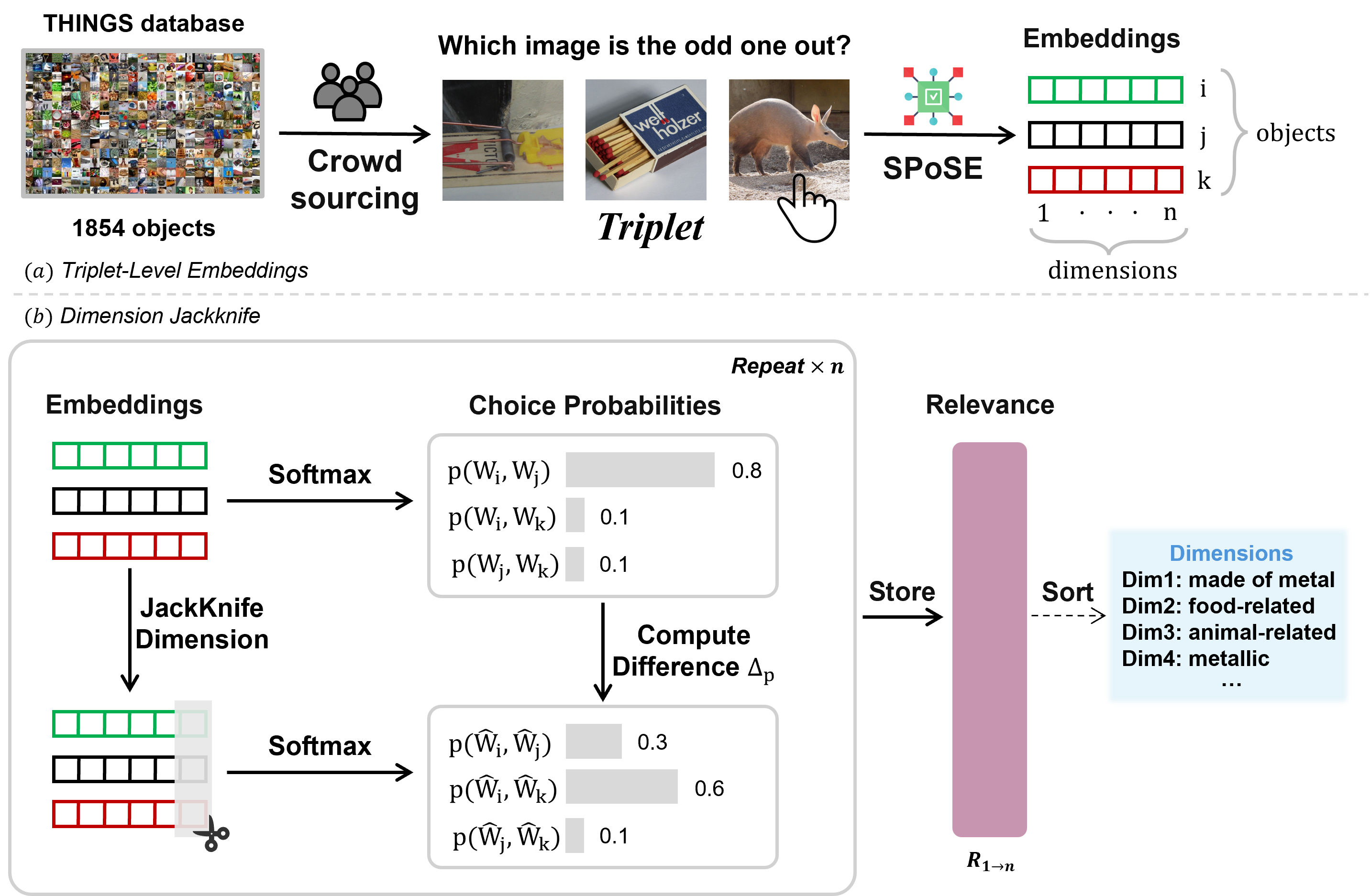
Build on THINGS: 4.70 million odd-one-out judgments spanning 1,854 object concepts, plus a 66-dimensional interpretable embedding (Hebart et al., 2020, Nat Hum Behav).

Cognitive Dimension
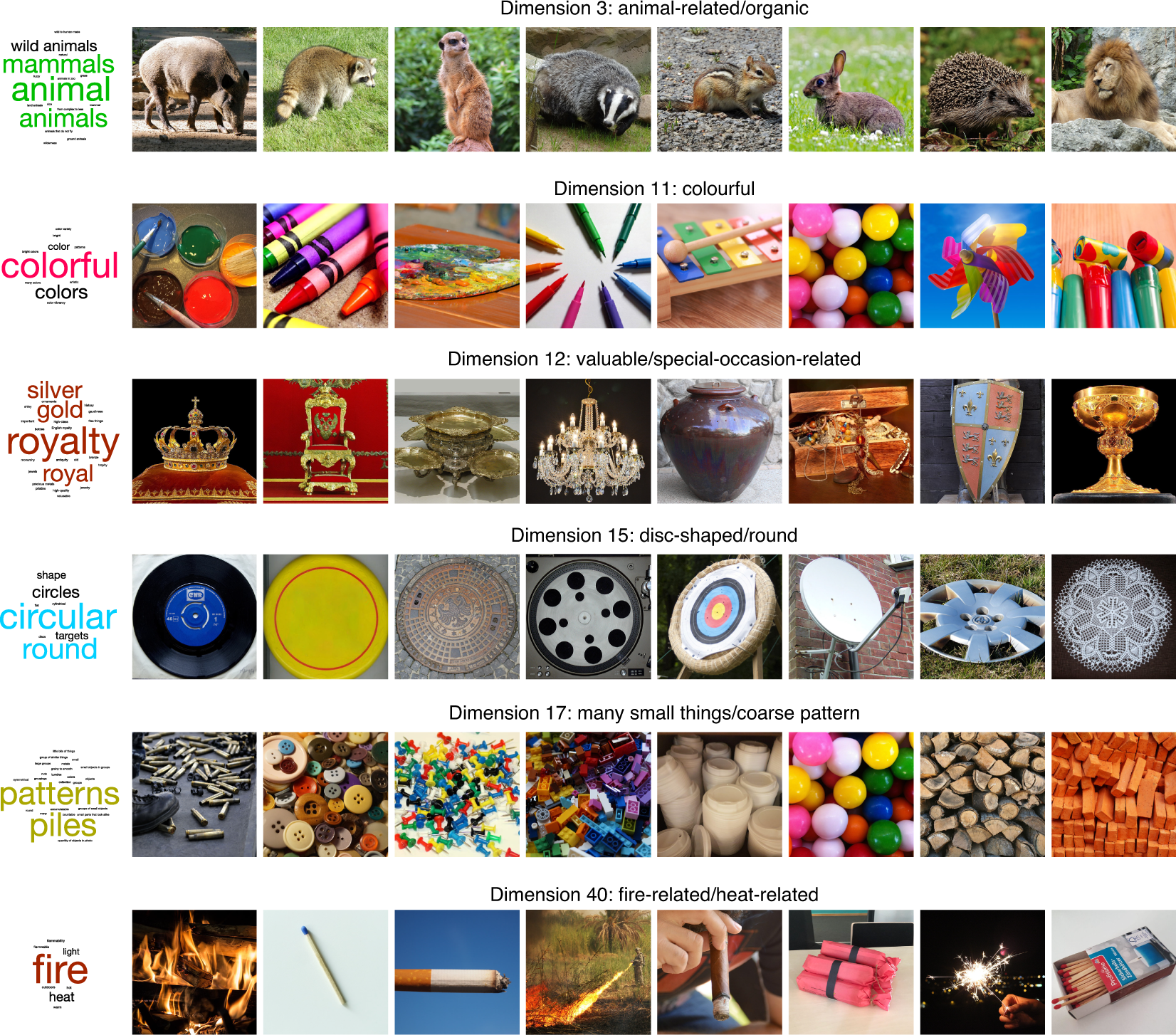
Represent objects along 66 dimensions

Adopt an established SPoSE embedding to capture the most explainable variance in similarity judgements and produce multidimensional highly reproducible and meaningful object dimensions that represent various conceptual and perceptual properties of those objects.

Triplet-Level Attribution
Infer the decision dimension

For each triplet, assess the relevance of each semantic dimension by individually pruning it from the embedding space and measuring the change in softmax probabilities. The dimension inducing the maximum change is identified as the most salient semantic dimension.

Reasoning Enhancement
Turn dimension into rationale

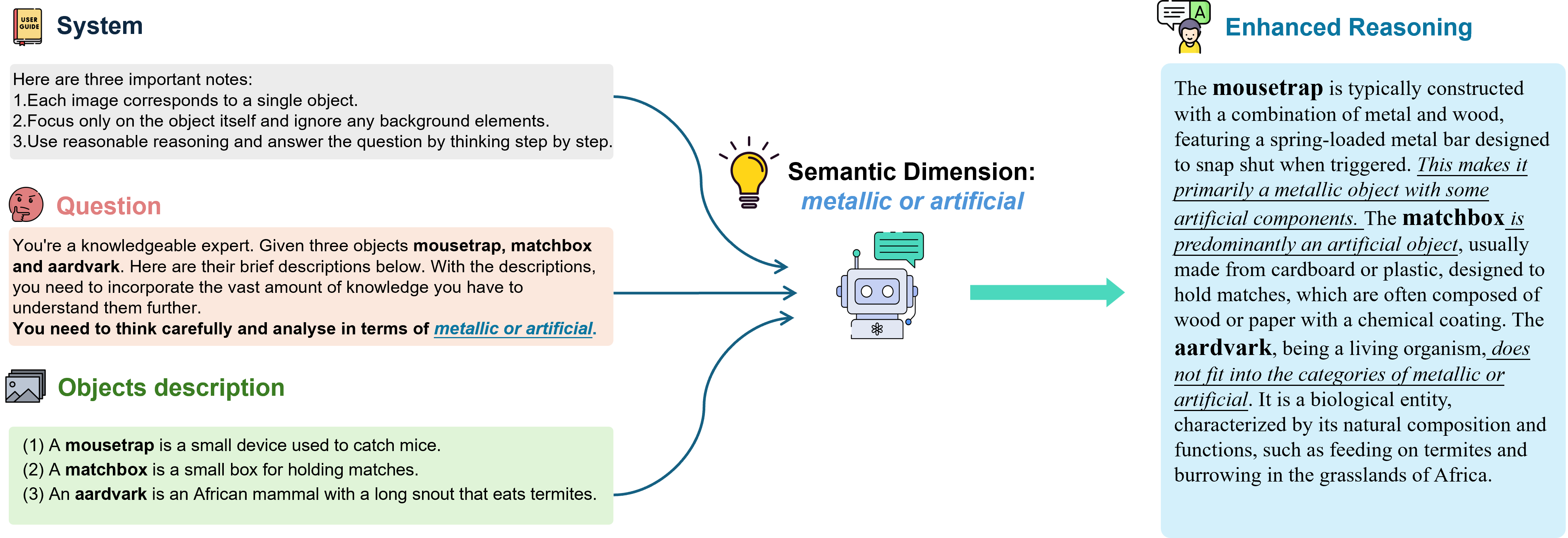
Given textual description and most salient semantic dimension, use an LLM to generate chain-of-thought rationale that elucidates how this dimension drives human reasoning and decision-making.

General Capability trade-off
Maintain general performance

CogAlign consistently improves MMMUval by 3.12 - 4.34, while yielding declines of 0.05 - 3.58 on MMBenchen, test, suggesting benchmark-dependent trade-off in general multimodal capabilities rather than uniform capability degradation.

Better Behavior
Improve human consistency

On 453,642 held-out THINGS triplets, CogAlign improves human consistency over both Direct and CoT baselines across Qwen3-VL model scales (4B to 30B-A3B), maintaining stable accuracy range of 56.21 - 56.99.

Neuroscientific Analysis
Toward representational alignment

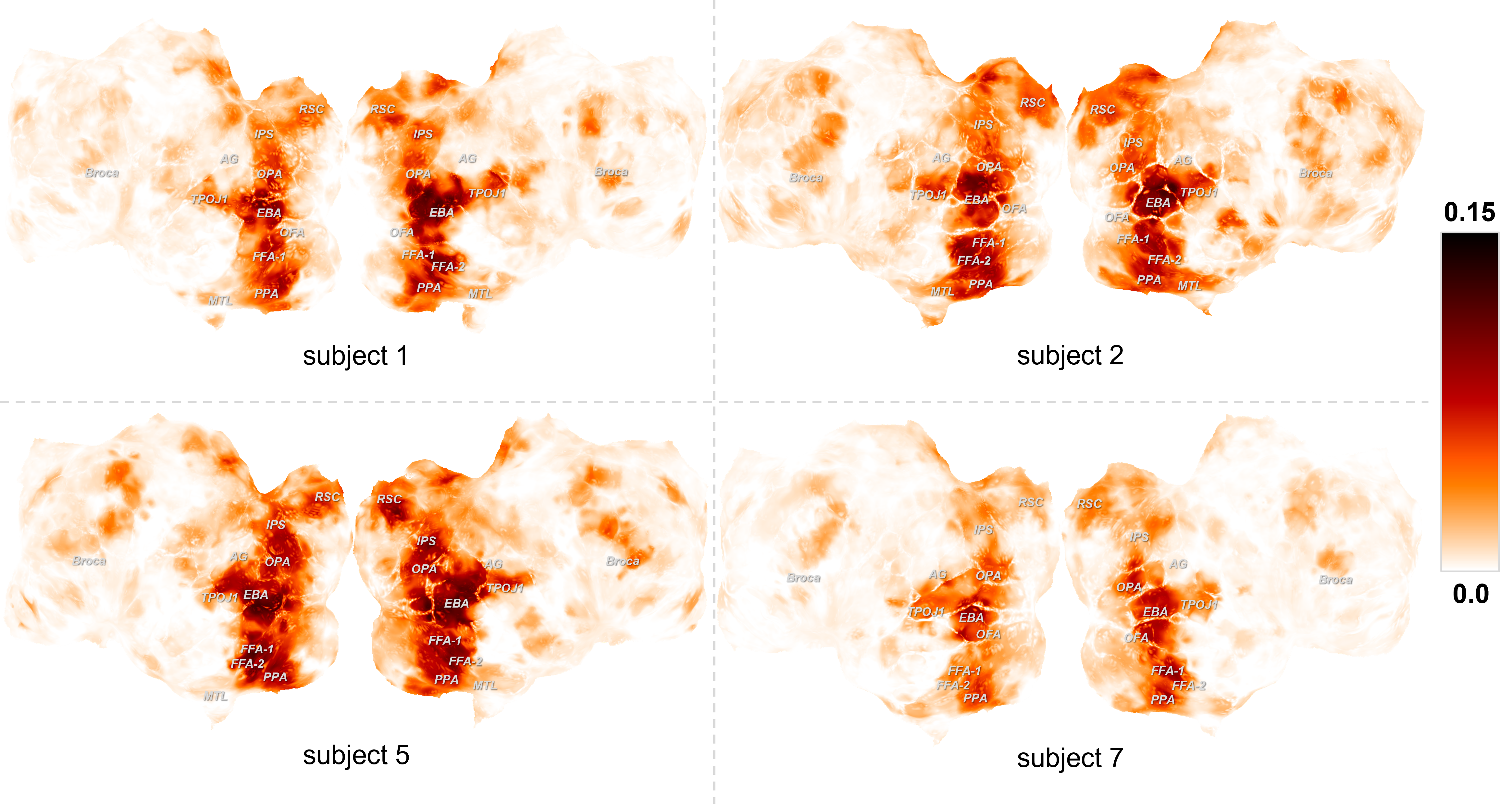
Searchlight RSA comparing MLLMs internal representation with human brain, revealing improved geometry alignment across four subjects on the independent NSD fMRI dataset.
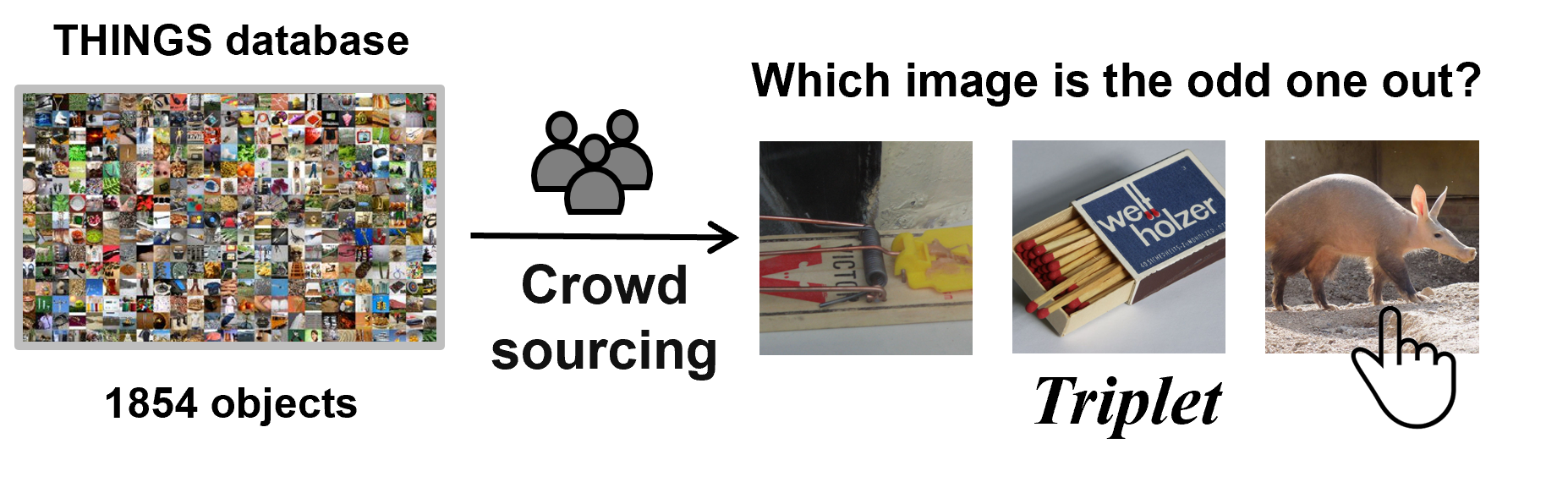
Natural objects pairwise similarity
Choose the one that is the least similar to the other two.
Behavior-derived semantic embedding
Illustrative dimensions from the behavior-derived embedding, such as animal-related, food-related, and metallic or artificial.
Jackknife-based attribution method
d∗ = argmaxD |pfull − pwithout-d|.
Pipeline for reasoning enhancement
Input: triplet description and semantic dimension. Output: enhanced reasoning.
MMMU and MMBench benchmarks
Qwen3-VL Instruct models across 4B and 8B scales.
Benchmark
Scale
MMMU
4B
Baseline
CogAlign
Human consistency
Qwen3-VL Instruct models across 4B, 8B, and 30B-A3B scales vs. Centaur on THINGS held-out.
Direct
CoT
CogAlign (our)
Noise Ceiling
Centaur 51.96 70B
Noise Ceiling 68.74 human
Robustness 56 ~ 57 CogAlign
Cortical projection visualization
Darker colors indicate better CogAlign alignment with human brain over Baseline.

Beyond Prompting

Explicit semantic guidance falls short.

Human Consistency
Qwen3-VL 4B Instruct · Prompting vs. CogAlign
S-CoT 53.37
d*-CoT 49.01
FS-CoT 52.70
CogAlign 56.81

+ 3.44 pp over standard CoT.

On Qwen3-VL 4B, both the most salient semantic dimension CoT (d*-CoT) and full-space CoT (FS-CoT) underperform standard CoT (S-CoT), achieving accuracies of 49.01 and 52.70, respectively, compared to 53.37 for S-CoT. CogAlign achieves 56.81, outperforming all three prompting strategies and demonstrating that semantic dimension guidance alone is insufficient.

Supervision Signals Impact

Supervision signals from dimension-grounded rationales matter.

Baseline: CoT generation. Supervision Signals: decision option (Choice-only), dimension labels (CogDim), and dimension-grounded rationales (CogAlign).

Across MLLM Families

Gains across Qwen2.5-VL, Qwen3-VL, and Gemma3 instruction models.

Across five models spanning Qwen2.5-VL, Qwen3-VL, and Gemma3, CogAlign improves human consistency by 0.8 - 4.7 pp over CoT baselines on 453,642 held-out THINGS triplets. On Qwen2.5-VL-7B, behavioral representational similarity improves from 73.3 to 80.9, indicating that CogAlign enhances both agreement and alignment with human representational geometry.

Takeaways

Beyond behavioral mimicry.  Convert behavior-derived semantic dimensions into interpretable linguistic rationales, guiding MLLMs to move beyond outcome imitation toward human cognitive processes.
Gains from CogAlign.  Improve behavioral consistency and alignment of representational geometry.
Toward cognitive pathway.  Introduce a general, data-efficient framework for injecting population-level cognitive priors into MLLMs, facilitating more controllable, consensus-consistent models.

Citation

@misc{e2026aligningmllmslatentstructure,
  title         = {Aligning MLLMs with the Latent Structure of Human Cognition via Behavior-Derived Semantic Dimensions},
  author        = {Ning E and Changde Du and Yizhuo Lu and Huiguang He},
  year          = {2026},
  eprint        = {2610.41951},
  archivePrefix = {arXiv},
  primaryClass  = {cs.CL},
  url           = {https://arxiv.org/abs/2610.41951}
}